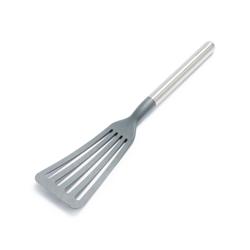
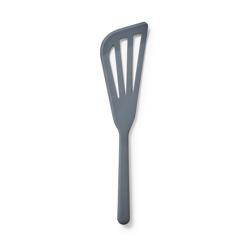
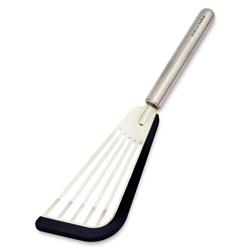
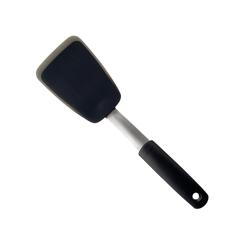
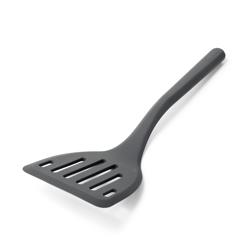
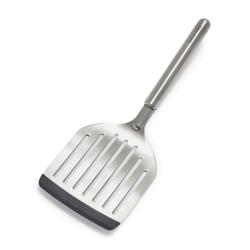
Flexible fish spatulas, also called fish turners, are kitchen tools with a thin, angled, slotted blade that slides beneath delicate foods for lifting and turning. The blade bends slightly against the cooking surface, helping support a fish fillet without tearing its tender flesh or disturbing a crisp crust. Slots allow excess cooking fat to drain back into the pan, while the broad blade gives food more support than a narrow utensil. That combination makes a fish spatula useful well beyond seafood: fried eggs, pancakes, vegetable fritters and thin cutlets can all benefit from a gentle lift. For a skin-on salmon fillet, the thin leading edge can ease beneath the skin once it releases from the pan; for a flaky piece of cod, the blade supports more of the underside during the turn. The most useful amount of flexibility depends on what is cooking. A blade with a little more give can follow the curve of a skillet, while a firmer blade may feel steadier beneath a thicker portion. Flexible should not mean floppy: the blade needs enough strength to carry food from the pan to the plate without sagging excessively. Shape matters just as much as flexibility. A longer blade can support an elongated fillet, while a more compact turner may be easier to maneuver around several smaller portions. An angled front edge helps approach food from the side, particularly when the pan is crowded. Some fish spatulas have an asymmetrical shape intended for a particular hand, so left-handed cooks may prefer a matching design or a more symmetrical blade. For anyone who has watched a carefully browned fillet break apart during plating, these details have a practical purpose. A suitable fish turner offers support where a fork or narrow spatula may leave part of the food hanging over the edge, making it easier to preserve both the texture and presentation of dinner.
Materials help determine where a flexible fish spatula belongs in the kitchen. Thin stainless steel blades are valued for their combination of flexibility, strength and a fine edge that can get beneath food with little disturbance. Bare metal is generally better suited to uncoated cookware, such as stainless steel or cast iron, than to surfaces that can scratch. For nonstick cookware, a turner with a suitable silicone coating or another nonmetal contact surface may be a better match, provided the cookware and utensil manufacturers approve that use. A coated edge may feel thicker than bare steel, so there can be a trade-off between protecting the pan and getting under especially thin, delicate food. Heat resistance also varies by material and construction; the stated limit applies to the particular utensil, not every fish spatula made from a similar material. Keeping the handle and blade away from direct flame or an exposed heating element helps prevent damage. Beyond material, the fit between spatula, pan and hand makes a noticeable difference. A wide blade needs room to lie close to the cooking surface, and a deep-sided pan can limit the angle of approach. A smaller skillet may be easier to navigate with a narrower blade, while a larger cooking surface leaves space for a broader turner. Handle length and shape influence control, too. A comfortable grip should make it easy to guide the edge beneath food without twisting the wrist awkwardly, and a secure connection between handle and blade helps the tool feel steady during lifting. Rounded handle edges can be more comfortable during repeated use, while pronounced grooves or bulky shapes may not suit every hand. For related utensil shapes, the
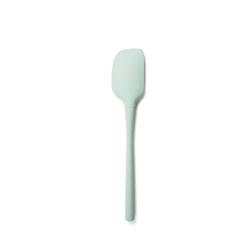
Flexible Spatula collection provides another place to look, with the intended task guiding the choice. A fish turner’s flat, slotted blade is designed primarily to lift and turn; it serves a different purpose from a soft scraper made to sweep batter from a mixing bowl.
Care and construction are worth considering for a tool that may become part of everyday cooking. Stainless steel resists corrosion, but cleaning away food residue and drying the blade thoroughly still matter, especially around slots and the point where the blade meets the handle. Dishwasher suitability depends on the entire utensil, including its handle, coating and attachments, rather than the blade material alone. Wooden handles generally call for hand-washing and prompt drying instead of soaking, while coated blades benefit from cleaning tools that will not nick or abrade their surfaces. Following the manufacturer’s care directions helps preserve both the finish and the connection between components. Smooth edges, a firmly attached handle and a blade that returns to its original shape after ordinary use are useful signs of sound construction. Flexibility is intended to help with turning food, not prying stuck pieces loose or scraping aggressively across a pan. Even a thin blade works best when food has had enough time to develop a crust and release; forcing it underneath too soon can tear the surface the cook is trying to preserve. Storage deserves a little thought as well. A fish spatula should have enough room in a drawer or utensil holder that its blade is not trapped under heavy tools or bent out of shape. For a first kitchen, it can be a practical addition for someone learning to cook fish, fry eggs or turn a pancake without folding it in half. Experienced cooks may appreciate a shape that better fits a favorite skillet or a handle that feels more natural in the hand. As a gift, a flexible fish spatula suits someone who enjoys seafood or appreciates thoughtfully chosen everyday tools, particularly when the blade material matches the cookware they use. Its appeal is straightforward: less wrestling with fragile food, more support during turning and a cleaner transfer from pan to plate. The right fit earns its place through familiar meals rather than a single specialized recipe.