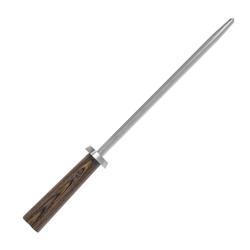
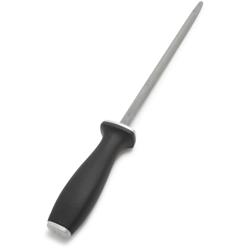
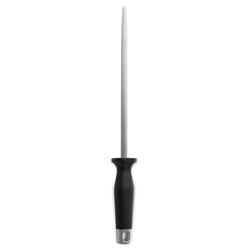
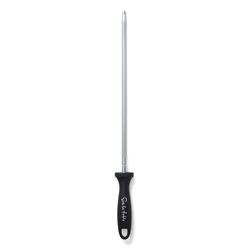
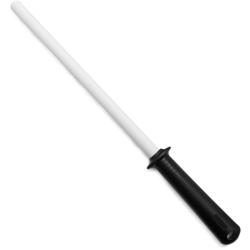
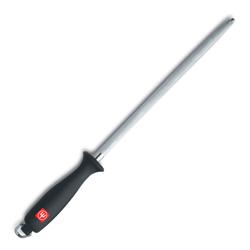
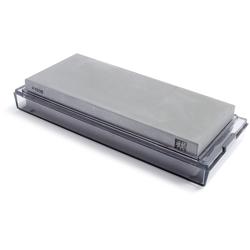
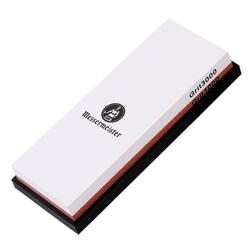
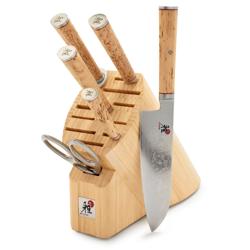
Honing steels for handcrafted knife sets help maintain cutting performance between sharpenings, keeping well-made blades ready for everyday prep. A traditional steel honing rod primarily straightens and smooths small irregularities along a compatible knife’s edge, while ceramic and diamond-coated rods remove metal to refine or refresh it. Honing is maintenance rather than a complete substitute for sharpening: a blade with a worn, chipped or substantially rounded edge needs more than a few passes on a rod. That distinction matters when choosing a companion for handcrafted knives, where the steel, heat treatment and edge geometry can vary considerably from one maker to another. The right match depends on those characteristics, not simply on whether a knife is handmade, forged or finished with a patterned blade. Traditional steel rods are often suited to softer-to-medium-hardness Western-style knives whose edges respond well to regular honing. Fine ceramic rods can suit some harder blades, provided the knife maker recommends them, but very thin or brittle edges may need maintenance on a whetstone instead. For someone who chops herbs, slices sandwiches and dices vegetables most days, a compatible honing rod can help preserve the controlled cutting feel that makes a favorite knife satisfying to use. Think of a chef’s knife making clean cuts through parsley rather than crushing the leaves, or a utility knife slicing neatly through a ripe pear. Those small moments make edge maintenance useful beyond special meals or ambitious cooking projects. A thoughtfully chosen rod belongs alongside the knives as a practical care tool, whether the collection consists of a few carefully selected blades or a coordinated block set. Shoppers comparing
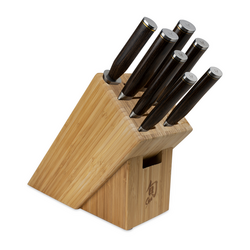
Forged Steel Knife Block Sets can consider compatible edge-care tools at the same time, paying attention to the maker’s recommendations rather than assuming every forged blade requires the same treatment.
Material and surface finish are important considerations when selecting a honing rod for a handcrafted knife set. Steel rods may have smooth, finely textured or more pronounced ridged surfaces, and those differences affect how gently they work against the edge. A finely finished surface is generally a more conservative choice for routine maintenance than an aggressively textured one, although compatibility still comes first. Ceramic rods are abrasive, even when their surface feels smooth to the touch; a fine ceramic rod can lightly remove metal while refining an edge. Their usefulness does not make them universally appropriate for every Japanese-style or high-hardness knife. Hardness alone is not enough to determine compatibility, especially when blades have unusually thin edges or specialized grinds. Diamond-coated rods are typically more abrasive and can remove metal more quickly, making them a different choice from a traditional steel intended mainly for alignment. For a mixed collection, one rod may not meet every blade’s needs. A sturdy Western-style chef’s knife and a delicate slicing knife can require different care despite sharing the same block. Rod length also affects fit and ease of handling. A useful starting point is a working rod at least as long as the longest compatible blade, with an additional 1 to 2 inches providing room for a comfortable sweep. The working length excludes the handle, so overall dimensions alone can be misleading. For many household collections, a 10-inch or 12-inch working rod offers practical space for maintaining a chef’s knife without feeling cramped. Handle shape, balance and a substantial finger guard deserve equal attention. A secure grip is especially helpful during extended meal prep, when hands may be tired from trimming vegetables or portioning meat. Some rods include angle guides that help with positioning, but their preset angles should match the knife maker’s specifications. Familiar edge angles such as 15 or 20 degrees per side are not interchangeable recommendations for every blade. The best fit is a tool that supports the knife’s existing geometry and feels manageable in the cook’s hand.
Care and storage influence a honing rod’s durability just as they do the knives it maintains. Steel rods are generally resistant to everyday knocks, but their surfaces still need cleaning and protection from prolonged moisture. Ceramic rods resist wear well in normal use yet can chip or break if dropped onto a hard floor. Diamond coatings can wear over time, particularly under excessive pressure, so an abrasive surface should not be treated as indestructible. Manufacturer care instructions should govern cleaning; hand-washing or wiping as directed, followed by thorough drying, is often preferable to exposing a handle and working surface to a dishwasher cycle. Ceramic surfaces may develop gray streaks from transferred blade metal and need an approved cleaning method to keep the abrasive surface working effectively. Storage should prevent the rod from knocking against knife edges or other hard tools. A properly sized block slot, protective sleeve or separate drawer space can keep it accessible without leaving it loose among utensils. These practical details are especially relevant in compact kitchens, where a longer rod may be comfortable to use but difficult to store. Intended use matters, too: honing rods are generally associated with compatible straight-edged kitchen knives, not serrated bread knives, ceramic knives or every specialized blade in a set. Gentle, controlled contact matters more than speed or force, and vigorous honing can damage an edge rather than improve it. A cook who notices a knife slipping on tomato skin or requiring more pressure through an onion should assess whether the edge needs honing or actual sharpening instead of repeatedly reaching for the rod. As a gift, a compatible honing steel is a thoughtful companion to a handcrafted knife collection, particularly for someone who enjoys cooking from scratch or has begun investing in lasting kitchen tools. Knowing the recipient’s blade types and storage setup makes that choice more personal and useful. For experienced cooks and enthusiastic beginners alike, the value lies in a good match: an appropriate surface, comfortable handling and care requirements that fit naturally into everyday kitchen habits.