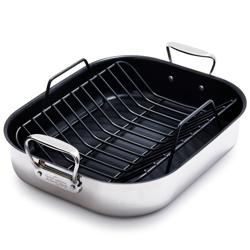
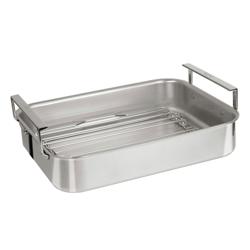
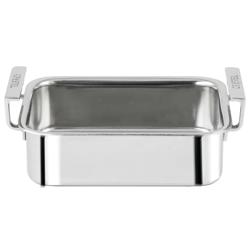
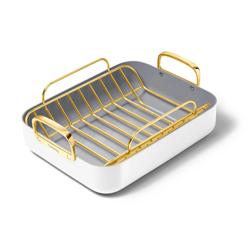
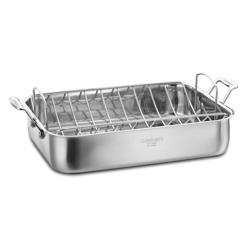
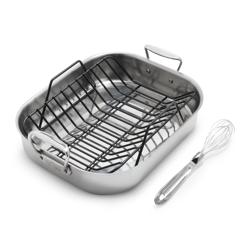
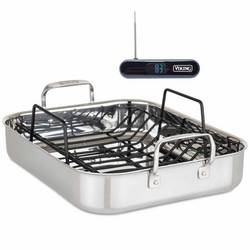
Handles for stainless steel roasting pans should provide a secure, balanced grip, enough clearance for oven mitts and strong attachment points that support a fully loaded pan. Upright loop handles, often secured with rivets, are a common design for lifting substantial roasts and moving cookware between oven and counter. Their shape matters just as much as their appearance: a generous opening gives covered hands room to grasp the handle without pressing against the hot pan wall, while a smooth, rounded profile helps distribute pressure across the grip. That difference becomes noticeable when a roast chicken is surrounded by potatoes or a large cut of beef shares the pan with vegetables and cooking juices. Handles on opposite ends allow a two-handed lift, helping keep the pan level so liquids stay where they belong. Height and placement deserve attention, too. Taller handles can be easier to reach around the edge of a roasting pan, but they also contribute to its overall height. Handles that extend outward add to its overall length, which matters when checking oven clearance, cabinet space or the distance between a sink and a drying area. The most useful fit accounts for the entire pan, including its handles, rather than the cooking surface alone. A compact roasting pan with comfortable handles can be more manageable for smaller meals, while a larger pan needs a handle arrangement suited to its greater loaded weight. For any size, consider how the grip feels with thick oven mitts rather than bare hands alone. An opening that looks generous on a countertop may feel cramped once protective fabric fills the space. Balanced placement, comfortable contours and room around the knuckles help make lifting more controlled. A clear route to a sturdy, heat-safe landing surface completes the setup, especially when the pan holds bubbling juices that can shift as it moves.
Material and construction influence how roasting pan handles perform over time. Stainless steel is valued for its corrosion resistance, strength and ability to tolerate the heat involved in roasting, although the oven-safe limit of any cookware depends on the complete construction and the manufacturer’s instructions. All-metal handles avoid the temperature restrictions associated with some plastic or coated components, but they should never be assumed to stay cool. Stainless steel handles can become very hot in the oven and require dry oven mitts or suitable potholders. Riveted handles are attached with fasteners that pass through the pan wall, creating a mechanical connection. Welded handles use a different attachment method and may leave a smoother interior surface around the connection. Neither attachment style alone establishes quality; sound construction, appropriate materials and a secure connection all matter. A well-made handle should sit firmly without wobbling, and its edges should feel smooth rather than sharp. For an existing pan, looseness, cracking or distortion around a handle attachment calls for an assessment before the pan carries another heavy meal. Replacement handles are not universal. Matching the original attachment method, mounting-hole spacing, hardware and handle shape is essential, along with confirming that the replacement is approved for the pan and its intended oven use. Similar-looking parts may not provide the same fit or load-bearing strength. Care also affects the condition of these connections. Roasting juices and grease can collect around rivet heads, seams and the underside of a handle, so those areas benefit from careful cleaning after the pan has cooled. Warm, soapy water and a nonabrasive sponge are useful for routine care; follow the cookware’s directions for stubborn residue, cleaning products and dishwasher use. Thorough drying helps prevent water spots and keeps attachment areas easier to inspect. Stainless steel resists rust, but it is not immune to damage from unsuitable cleaners or prolonged exposure to harsh substances.
The right handle design supports the way a roasting pan is used, from a simple dinner for two to a generous meal shared around the table. Someone who frequently prepares whole chickens, pork shoulders or large vegetable roasts may place particular value on roomy loops and a reassuring two-handed grip. For a cook working with a smaller oven or limited storage, handles that remain closer to the pan can offer a practical advantage, provided there is still sufficient space for protected hands. The roasting rack matters in this arrangement as well: its position and any raised grips should leave the pan handles accessible, and the rack should fit without interfering with a secure hold. Pan handles are the lifting points for the loaded cookware; a removable rack serves a different purpose and should not be treated as a substitute for them. Comfortable handles also make the less dramatic parts of cooking easier, such as positioning an empty pan, carrying it to the sink after it has cooled or returning it to a shelf. For cooks building a coordinated cookware collection,
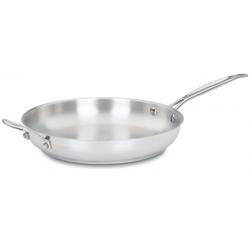
Stainless Steel Handle Skillets offer a related category to consider, though the grip needed for a skillet differs from the paired support useful on a roasting pan. Each shape should suit its own lifting and cooking tasks. As a gift, a thoughtfully chosen roasting pan can suit someone setting up a kitchen, replacing worn cookware or expanding beyond everyday stovetop meals. Handle comfort, loaded weight and storage fit are more personal—and often more useful—considerations than a polished finish alone. Picture the recipient lifting a pan of browned vegetables, resting a roast before carving or washing up after dinner. Handles that feel secure throughout those ordinary moments contribute to cookware that earns its place in the kitchen. Paired with the right pan size and sensible care, they help make roasting a comfortable, repeatable part of cooking at home.