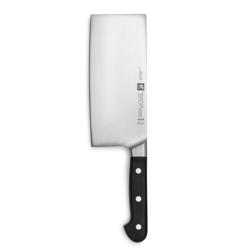
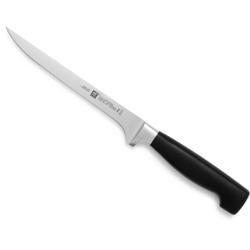
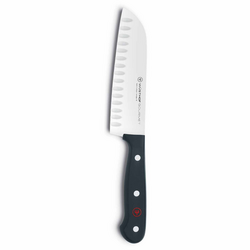
Professional boning knives are designed for the careful work of separating meat from bone, trimming fat and cutting through connective tissue with control. Their narrow blades, typically 5 to 6 inches long, offer the maneuverability needed to work around joints, ribs and other curved surfaces without sacrificing reach. A flexible boning knife bends gently as it follows the contours of poultry, fish and smaller cuts, helping make clean, close passes around bones while minimizing waste. A stiff boning knife provides more resistance and leverage, making it a practical choice for denser cuts, larger portions and tasks that call for firm downward pressure. Curved blades can be especially helpful when following the natural shape of a joint or rib cage, while straighter profiles offer a familiar, direct feel for trimming and portioning. Professional boning knives are useful in a busy restaurant or butcher shop, but they also earn their place in a well-equipped home kitchen. A home cook preparing a whole chicken for roasting, trimming a pork shoulder for slow cooking or portioning steaks for the freezer can use one to work with greater precision than a broad chef’s knife allows. Anglers and hunters may appreciate the control a specialized blade brings to cleaning fish or preparing game, while anyone who regularly buys larger cuts from a butcher can use one to trim silverskin and excess fat before cooking. For many cooks, the difference becomes clear in the small details: a blade that slips neatly along a bone, a joint that separates without tearing and a trimmed cut that cooks more evenly from edge to edge. These knives can also make a thoughtful gift for a dedicated home cook, outdoor enthusiast or aspiring butcher who enjoys learning traditional preparation techniques. Pairing one with a sturdy cutting board, a sharpening tool or other meat-preparation essentials can create a useful gift for a new kitchen, a frequent host or someone who looks forward to cooking hearty meals as the weather cools.
When choosing among Professional Boning Knives, start with the work you do most often and the way you naturally hold a knife. Flexibility is one of the most important considerations. Flexible blades are well suited to poultry, fish and delicate trimming because they can curve around bones and help maintain close contact with the surface. Stiffer blades are better for beef, pork, lamb and other substantial cuts where extra stability is useful. Blade length also affects handling: a 5-inch blade feels nimble in tight spaces and is easy to guide around smaller portions, while a 6-inch blade offers a little more reach for larger cuts. Look for a comfortable handle with a secure, slip-resistant surface, since meat preparation often involves wet or greasy hands. A well-shaped handle should feel balanced without forcing the wrist into an awkward angle, and a pronounced bolster or guard can add confidence when working near joints. High-carbon stainless steel is a popular choice because it can hold a sharp edge while resisting the moisture and acids found in meat and seafood. Even a durable steel benefits from proper care, however. Rinse the blade after use, wash it according to the manufacturer’s instructions, dry it promptly and store it where the edge will not strike other utensils. Regular honing can help maintain alignment between sharpenings, while a professional sharpening service or suitable sharpener can restore an edge that has become dull. Always cut on a stable board and guide the blade with deliberate movements rather than forcing it through bone—boning knives are intended to work beside bones, not through them. During the cooler months, when braises, roasts and slow-cooked meals often become part of the kitchen routine, a dependable boning knife can simplify the preparation that happens before the pot or roasting pan does its work. Explore this selection alongside our broader range of
Boning Knife options to find a blade suited to your cutting style, preferred proteins and everyday kitchen habits.