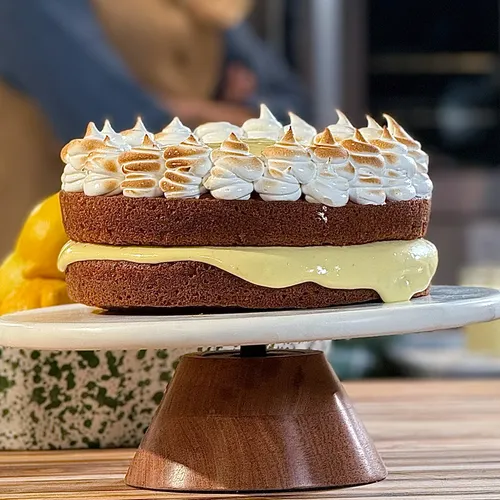
Lemon Meringue Cake
By Carla Hall
Lemon Meringue Cake
By Carla Hall
Yield/Serves:
12 - 16
Lemon Curd
- 2 or 3 large organic/ unwaxed lemons or well- scrubbed waxed lemons, at room temperature
- 1 cup / 218g granulated sugar
- 1/2 teaspoon fine sea salt
- 8 tablespoons / 1 stick / 113g unsalted butter, at room temperature
- 6 large eggs, at room temperature
- 1/2 cup / 110g well-chilled heavy cream
- 1 teaspoon vanilla bean paste or pure vanilla extract
Lemon Oil Cake
- Safflower or sunflower oil and all-purpose flour, for the pans
- 2 1/2 cups / 315g all-purpose flour
- 1 1/2 cups / 327g granulated sugar
- 1 1/2 teaspoons baking soda
- 1 teaspoon fine sea salt
- 1/4 cup / 55g expeller-pressed safflower or sunflower oil
- 3 large eggs, at room temperature
- 1/2 cup / 110g Lemon Oil (recipe follows)
- 3/4 cup / 171g whole buttermilk
Meringue
- 6 large egg whites
- 1 1/4 cups / 273g granulated sugar
- 1/2 teaspoon cream of tartar
- 1/2 teaspoon fine sea salt
- 2 teaspoons vanilla bean paste or pure vanilla extract
- 1 cup / 220g expeller- pressed safflower or sunflower oil
- 2 organic/unwaxed lemons, seeded and thinly sliced
Make the lemon curd
1. Use a vegetable peeler to remove strips of zest from each lemon, being careful not to include too much white pith. Coarsely chop them. Squeeze the lemons to yield 1∕2 cup / 115g juice.
2. In a blender, combine the sugar, salt, and chopped lemon zest. Process until finely chopped. Add the butter and continue to process, forming a creamy mixture, about 30 seconds. Stop to scrape down the blender as necessary.
3. Separate the eggs into whites and yolks, reserving the whites in the refrigerator for the meringue (see Hot Tip). Add the egg yolks to the blender one at a time, incorporating after each addition. Add the lemon juice and blend until the mixture is smooth and creamy, about 30 seconds.
4. Set a fine-mesh sieve over a medium saucepan. Pour the blended lemon mixture through the sieve into the pan, discarding any solids. Cook over medium heat, constantly stirring with a wooden spoon or sturdy spatula, until glossy, slightly darkened in color, and the temperature of the mixture registers about 175°F on an instant-read thermometer (or just before boiling), about 10 minutes. The curd should be thick enough to coat the back of a spoon. Immediately strain the curd through the same fine-mesh sieve (no need to wash it) into a clean bowl or container, discarding any solids. Place plastic wrap directly on the surface of the curd (this will keep a skin from forming). You will have about 2 cups. Refrigerate for at least 1 hour, or until completely chilled.
5. In a medium bowl, use a balloon whisk to beat the heavy cream (by hand) to soft peaks, 4 to 5 minutes, adding the vanilla near the end.
6. Remove/discard the plastic from the chilled lemon curd and whisk to loosen, then fold in the vanilla whipped cream until fully incorporated. Cover and refrigerate until ready to use. (At this point the lemon curd
mixture can be refrigerated for up to 3 days.)
Make the lemon oil cake
7. Preheat the oven to 350°F. Grease two 9-inch round cake pans with a little oil. Line the bottoms with rounds of parchment paper, grease the parchment with more oil, and dust the pans with flour, tapping out any excess.
8. In a stand mixer fitted with the paddle, combine the flour, sugar, baking soda, and salt. Beat on low speed until blended.
9. Add the 1∕4 cup safflower oil, beating just to coat the dry mixture. Add the eggs one at a time, beating until incorporated after each addition and scraping down the sides of the bowl as necessary. Add the lemon oil and beat on low speed until incorporated, another minute. Gradually add the buttermilk, beating just until incorporated to form a smooth batter, about 30 seconds. Do not overmix. Divide the batter evenly between the cake pans.
10. Bake until a tester inserted in the center comes out clean and the cake pulls away from the sides of the pan, 20 to 25 minutes.
11. Let the cakes cool in the pans on a wire rack for 10 minutes, then invert the cakes onto the rack and discard their parchment. Reinvert and then loosely wrap each cake layer in plastic wrap (this will help retain their moisture) and allow to cool completely on the rack or in the refrigerator. (At this point you can refrigerate the cakes for 1 day or freeze for up to 2 weeks.)
Make the meringue
12. In a heatproof mixer bowl, combine the reserved egg whites, sugar, cream of tartar, and salt. Place the bowl over a saucepan filled with no more than a couple inches of simmering water over low heat (do not let the water touch the bottom of the bowl).
13. Stir and scrape the mixture constantly with a stiff spatula until the sugar has completely dissolved, the mixture is foamy, and it registers 175°F on an instant- read thermometer, 8 to 10 minutes.
14. Transfer the mixer bowl to its stand, fitted with the whisk (or use a handheld electric mixer), and beat the mixture on high speed to form a glossy meringue with stiff peaks that has lightened in color, about 5 minutes. On low speed, mix in the vanilla. Transfer the meringue to a disposable piping bag fitted with a large round tip.
15. To assemble the cake, dab a bit of the meringue on a cake plate and place the first cake layer on top of the meringue (this will help secure it). Spread a thin layer of lemon curd over the surface. Pipe a generous/thick meringue ring around the edge of the cake layer and then fill the center with half of the lemon curd.
16. Place the remaining cake layer on top. Spread a thin layer of lemon curd on the surface. Pipe a generous/thick meringue ring around the edge of the second cake layer and fill the center with the remaining lemon curd. With an offset spatula, spread the remaining meringue over the top and sides of the cake, and then, using a spoon or small offset spatula, create dramatic dips and peaks. (Alternatively, frost the sides of the cake, using a small offset spatula, and then scrape the remaining meringue into a disposable piping bag fitted with a large round tip and pipe small mounds of the meringue on top of the meringue ring.)
17. If serving immediately, toast the meringue with a kitchen torch. For even browning, use sweeping motions and don’t get too close. Or cover and refrigerate for up to 1 day and bring to room temperature before toasting and serving.
Make the lemon oil
1. In a small saucepan, combine the oil and lemon slices and cook over medium heat until heated through and fragrant, about 5 minutes.
2. Reduce the heat to medium-low and cook for 10 minutes. Remove from the heat to cool/infuse for 10 minutes, then strain into a container, discarding the solids. Cover and refrigerate for up to 3 days if not using right away. If you’ve refrigerated the oil, stir or shake it well to liquefy before using.
Hot Tip: The eggs are separated into yolks (for the curd) and whites (for the meringue). If you are making the lemon curd more than a day or two in advance of the meringue, place the whites in an airtight container, freeze them, and then thaw them in the refrigerator overnight before using in the meringue.
Make-Ahead Tips: You can make the lemon oil and the lemon curd up to 3 days in advance. Wrapped well, the cake layers can be refrigerated 1 day in advance, or frozen for up to 2 weeks.